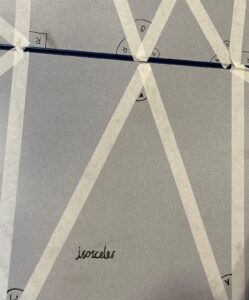
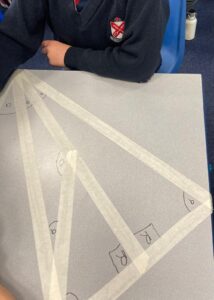
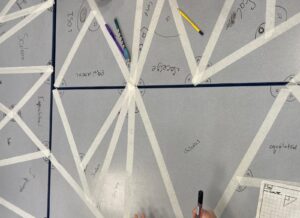
Starlings had great fun in maths this week, using the tables as their canvas to explore angles and triangles in a lively and memorable way!
The children began by recapping their learning about angles, confidently identifying acute, obtuse and right angles from earlier in the week. They then moved on to learning about the properties of different types of triangles.
Once the tables were filled with shapes, the children worked together to identify and label each triangle correctly. They discussed whether the triangles were scalene, isosceles or equilateral, and some children also spotted right‑angled triangles. There was some wonderful collaboration, mathematical language and discussion, with children supporting one another to make sure every triangle was labelled accurately.
This lesson was a fantastic example of our school vision to Love, Learn and Shine:
- 💛 Love – working together respectfully and supporting each other
- 📚 Learn – deepening understanding through discussion and exploration
- 🌟 Shine – showing confidence, curiosity and pride in their learning
🔺 Triangle Types – Key Definitions for Families
Here are the definitions the children have been learning in class:
- Equilateral triangle – all three sides are equal and all three angles are equal
- Isosceles triangle – two sides are equal and two angles are the same
- Scalene triangle – all sides and angles are different
Right‑angled triangle – has one right angle (90°)
 🏠 Try These Maths Activities at Home
Parents and carers can support learning at home with these simple activities:
✅ Questions to ask:
- Can you find a triangle around your house?
- What type of triangle is it? How do you know?
- Does it have a right angle?
- Are any sides the same length?
✅ Activities to try:
- Draw different triangles and label them as scalene, isosceles or equilateral
- Go on a shape hunt indoors or outdoors and spot triangles
- Use rulers or string to check if sides are equal
- Challenge your child to draw a triangle with one right angle
🌐 Useful Link
To support learning further, families can explore this excellent resource together:
👉
BBC Bitesize – Types of Triangles (KS2 Maths)