
The subject leader for Religious Education (RE&WV) is Mrs Robbins

They can be contacted by emailing admin@stpeters.ycway.uk using the subject title FAO of followed by the name of the subject leader. Emails typically receive a reply within 2-3 working days. Please note most of our subject leaders have a full-time teaching commitment.
With oversight and support from our Senior Leadership team subject leaders oversee and monitor the intent, implementation and impact of their subject.
Intent – The ambition and principles of our curriculum for our children. The curriculum content we expect children to learn. What we expect children to know.
Implementation – How the intentions are realised. The sequence and strategies used to ensure children know and remember more.
Impact – How we check and see if children know what we expect them to and how we help them further if needed. How knowledge and skills learnt improved and enriches their lives socially, emotionally, spiritually as well as academically.
Although RE is not part of the National Curriculum, schools still teach RE. Non statutory guidance is provided, which outlines what a well design RE curriculum should entail (this is outlined in our detailed rationale attached below). Our curriculum is based on the North Yorkshire Agreed Syllabus for RE which meets all elements outlined in the non statutory guidance.
RE supports children in becoming secure and fluent in the identified agreed core knowledge and skills. Fluency and security in this core knowledge allows children to explore concepts in greater depth whilst allowing children to find their own place within a diverse, multi-religious society. This then enables children to articulate informed responses about religion and non-religion and provides them with the opportunity to discover their own place in our world.
At St Peter’s the journey to becoming RE literate begins in the Early Years (EY). Our youngest children learn about RE following the appropriate EY units from the agreed syllabus which connect with the EYFS areas of learning known as ‘Understanding the World’ and ‘Personal, Social and Emotional Development’.
These will also be complemented by exploration of children’s interest and the ‘here and how’ gained from the observation, assessment and planning cycle. For instance, children will explore their own identity and listen to ideas of those around them, when taking part in circle time. Positive conversations are modelled and shared, to develop positive attitudes about the differences between people.
By the time children reach the end of Year Six they will have developed a secure religious understanding and will be working in line with age related national expectations. All children will have had the opportunity to visit religious buildings and hear from different faith leaders and people from different faiths and also from those who do not identify with any particular faith.
Related Development Matters Learning
Understanding the World
Personal Social and Emotional Development
As a church school we recognise the importance of teaching RE as an academic subject. We recognise are responsibility to teach it to a high standard taking into account our statutory duties as outlined in the Church of England Statement of Entitlement. The Statement of Entitlement details the expectations for religious education in Church of England schools
RE Statement of Entitlement 2026
The documents below outline in more detail the sequence children will follow in relation to Religious Education and the progression of knowledge.
RE Whole School Curriculum Overview 2026 -2027
To help children secure the intended factual subject knowledge we have developed a range of child friendly knowledge organisers to support our curriculum implementation. Some examples are attached below.
Knowledge Organiser – Resurrection
Knowledge Organiser – What Would Jesus Do UKS2
Knowledge Organiser RE – What does it mean for Muslims to follow God
KS1 Knowledge Organiser – What makes some places sacred UKS2
Knowledge Organiser RE – What does it mean to be a Muslim in Britain today
LKS2 Knowledge Organiser RE – Why are festivals important to religious communities
In Religious Education (RE), children are learning more than just facts about religions. They are learning about some of life’s biggest questions and ideas. Disciplinary knowledge organisers help guide them through this in a clear and supportive way.
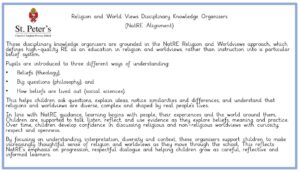
These organisers help children understand the core areas of RE&WV, including:
By setting this out clearly, children begin to see that RE is about both understanding others and thinking deeply for themselves.
We are pleased to share some examples of how knowledge and skills learnt have improved and enriched our children’s lives socially, emotionally, spiritually as well as academically.
‘In RE we learn about different world religions including Christianity, Islam and Judaism. This helps us understand how different people live. This will help us understand others better and get on well.’ – Year 4 child
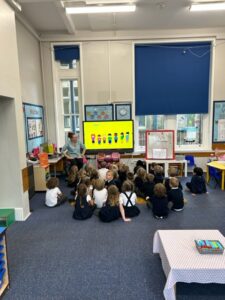
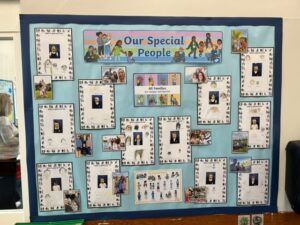
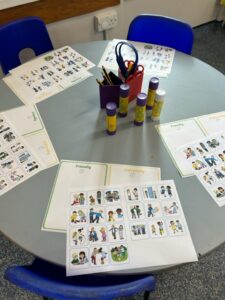
Through the unit ‘Which people are special and why’ Early Years children learn about who is special to them and why and the qualities of good friends. They learn about the disciples and how they were special friends to Jesus and how Jesus helped his friends through the story of Blind Bartamus. This impacts on their personal development and wellbeing positively influencing they way they treat others within and beyond school.

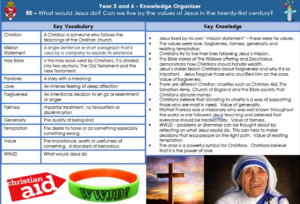
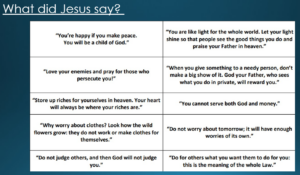
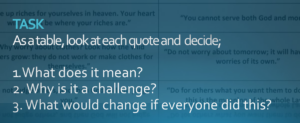
Learning tasks encourage children to reflect and think deeply about the subject content. This deep thinking impacts positively on the children as it helps secure the content into long term memory meaning children are well prepared to continue studying the subject in the future into Key Stage 3 and beyond. In the context of many of the RE units this deeper thinking impacts on children’s moral development helping them to consider a range of different perspectives developing empathy and understanding.
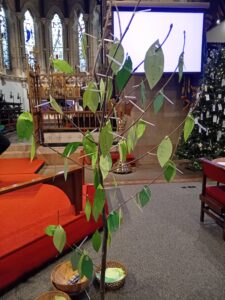
Children from lower school visited St Peter’s Church this morning as part of their Religious Education (RE) learning for this half term. Children have been exploring the question ‘ ‘Why is Christmas so special to Christians? and ‘What is the good news Christians believe Jesus brings.’
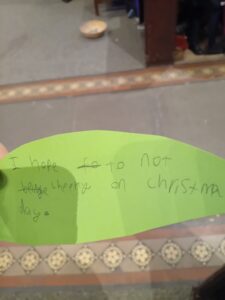
They received a very warm welcome from the Mrs Shaw and the St Peter’s team who talked to them about Advent and the nativity scene in church. The children had chance to pause and reflect and write their hopes or prayers to be added to the prayer tree.